The VSM Guide |
 |
An introduction to the
Viable System Model
as a diagnostic & design tool
for co-operatives & federations
Jon Walker
Version 3.0 (2006)
|
Introduction
Preface
Section 0: Cybernetic Eyes
Section 1: The Quick Guide to the VSM
Section 2: Case Studies
Hebden Water Milling 1985
Triangle Wholefoods 1986
One Mondragon Co-operative 1991
Section 3: Preliminary Diagnosis
Janus interlude
Section 4: Designing Autonomy
Section 5: The Internal Balance
Section 6: Information Systems
Section 7: Balance with the Environment
Section 8: Policy Systems
Section 9: The Whole System
Section 10: Application to Federations
Bibliography
Links
Appendix 1: Levels of Recursion
Appendix 2: Variety
|
Section 8: DESIGNING POLICY SYSTEMS
|
From the co-operative point of view, the way that policy is made and
implemented is without doubt the most important issue. The business
must pay its bills and make a profit, but all of the financial
issues are constraints: what the co-operative is really all about is
defined partly by its mission statement, and partly by the working
environment it creates for its members.
Central to this issue is the involvement that everyone has in making
policy.
In a small group this is easy: you have a meeting, discuss an issue
until some sort of consensus emerges, and the policy is made.
In a larger group the dynamics of large meetings make this
difficult, and choices have to be made about the methods of
involving everyone in all the important policy decisions, and how to
prevent the business degenerating into endless non-productive
meetings.
|
System 5: The Design of Policy Systems
|
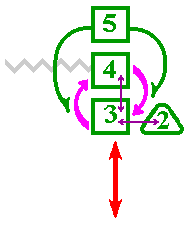
The VSM shows System 5 overseeing the interaction between System 4
(collecting environmental data .. making strategies .. ) and System
3 (overseeing the Operational units .. looking for ways of
generating synergy ... )
Assuming all of this running smoothly, the policy systems have very
little to do except to act as a watch dog over this process and to
ensure that policy is adhered to.
The principle of how policy is made is generally not an issue - most
people in co-operatives would agree that policy must express the
"will of the members", and that either meetings of all the staff or
of delegates representing all the staff are the way to do it.
|
Perhaps the biggest problem at Suma in 1986 was that everyone wanted to
be involved in every decision and the resulting proliferation of meetings
was getting unworkable. While policy clearly requires an input from every
member, it had become necessary to get some decisions made only by the
members directly involved.
The VSM contribution to this problem was:
- to make departmental decisions within each department.
- to appoint officers with an overview to make decisions about the
interaction of departments.
- to make all of this accountable to all members with clear mechanisms
to empower any 5 members to call a General Meeting.
- to look at all of this and the policy issues on a weekly basis so
that there is no chance of policy slipping away from the control of
the membership between infrequent meetings.
The situation is, of course, not completely clear. The exact nature of
"policy" is indefinable, and it is debatable whether some matters should
be decided by an officer or discussed by everyone.
The crucial factors are that:
- All officers are accountable
- Mechanisms exist to enable members to change the way that officers
are operating
- Clear policy issues cannot be made without the majority of all
members agreeing.
Step 14: Design of Policy Structures
| 14.1 |
Look at your systems for defining
new policy. Must all members be involved? Are they regular
enough? Do all members feel that their opinions are essential in
defining new policies?
|
| 14.2 |
Look at you systems for ensuring
policy is adhered to. Is everyone accountable? Are there
mechanisms to empower any group of members to call a General
Meeting?
|
|
Example 1
Suma has been discussed at length. If it may be criticised on its policy
systems it must be from the point of view of not letting the officers
make decisions on their own. Any slight modification of policy - which
could be seen as interpretation of existing policy - has to be discussed
by the entire membership.
There is little doubt that the weekly Hub/Sector system keeps everyone
involved in all policy matters.
Example 2
Other large co-operatives handle decision making in different ways.
They may use a weekly meeting of delegates to take the overview of the
current situation, and make decisions on their own initiatives (at Suma,
delegates report only their Sectors' views). They then have monthly staff
meetings to look at the weekly decisions and to make policy. All weekly
decisions and agendas may be pinned on a notice board and members may
intervene if they feel it is necessary.
Generally this system seems to work, although there are some grumbles
about lack of consultation.
|