Section 4: DESIGNING AUTONOMY
|
In this Section you will begin to look at the way that the various
parts of your organisation work together.
At the end of the Preliminary Diagnosis, you will have a picture of
the way your enterprise looks in terms of the "building blocks"
which compose it.
The rest of the manual looks at the interaction of these building
blocks, and is concerned with ensuring that the whole thing works
together in an integrated form.
The essence is organisational balance: of ensuring that the bits
which are charged with over-seeing the Operational units have the
capacity to do their job properly.
The first element of generating this balance is to give each
Operational unit as much autonomy as the organisation can handle,
without degenerating into separate and isolated parts.
|
Autonomy or Authority
If you have organisational problems such as lack of efficiency or jobs
just not getting done there are basically two options:
- You can appoint managers who have the authority to make sure that
these problems get dealt with.
- You can design a system which ensures that the problems are dealt
with autonomously.
The first option has been used for hundreds of years in all kinds of
society and it is only recently that its limitations are becoming clear.
The Management Gurus in the United States are now coming out with
statements like "Train the hell out of your workers and then get out of
their way".
This new emphasis on making all workers more autonomous has been obvious
to people in co-operatives for decades - what has been lacking is the
systems needed to ensure it works properly. There is no point in saying
"OK ... you're all autonomous now" and expecting the rest to take care of
itself.
The first essential is for each Operational unit to be clear about its
role within the whole organisation and should therefore produce its own
Mission Statement.
This may take some negotiation with everyone else, but will ensure that
the Operational unit works as an integrated part of a greater whole.
|
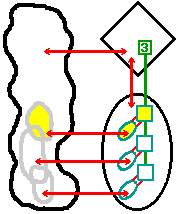
In Viable System Model terms, this issue concerns one Operational
unit and its relationship with System 3.
One Operational unit has been highlighted - it is shown interacting
with its environment.
The double arrow indicates the interaction between that Operational
unit and System 3.
The basic idea is clear: the unit should be free to do whatever it
wants without interference from anyone else as long as:
- It continues to function as an integrated part of the whole
organisation.
- It does not threaten the survival of the whole organisation.
|
 |
Allocation of Resources
Whatever your organisation, the Operational units will need resources.
They will need money and people in order to carry out their function.
This is the point at which the design process can begin.
System 3, which oversees the collection of Operational units must have a
financial aspect which is concerned with the overall financial picture for
the business. It is the job of financial System 3 to allocate resources.
Usually this will occur in the yearly budget rounds. Each unit will say
"We need £ £ £ in order to do our job", System 3 will add it all up and
say "Sorry, we don't have enough to give everyone everything they want,
who can make cuts?"
This process will continue until either the necessary cuts are made .. or
.. System 3 will make decisions about who gets what, in the light of
what's best for the whole organisation. (That is ... it optimises the
allocation of resources).
In most cases, the allocation will only happen once a year and thereafter,
each Operational unit will do its job according to the pressures put upon
it by the market or other parts of its own organisation.
This one way process (here's the money you need, and that's the end of my
job ...) works reasonably well as long as everything proceeds as normal,
but is totally incapable of dealing with problems.
The usual situation is as follows:
- Each Department gets its budget.
- Each Department carries on with very few guide-lines except to
maintain things as normal.
In the event of a dramatic collapse in productivity within a
department, it is possible that no-one would know for months and
severe damage could be done to the organisation.
The solution is clear - each department must be accountable.
This is the alternative: System 3 says: "Here are your resources -
you can have them as long as you do your job in the way we agreed."
Thus:
- Each Department has a clear Mission Statement and performance
targets.
- Each Department gets its budget so it can carry out its mission.
- Each Department must account for its performance on a continuous
basis to justify its use of resources.
- System 3 monitors performance to ensure resources are being consumed
in the optimum way decided in the yearly budget rounds.
Dealing with Problems: Intervention Rules
The question must arise: "If each Operational element is given autonomy,
how do you stop standards from sliding?"
The question is valid. A protocol must be in place which can deal with the
possibility of a group of people loosing heart and of letting their
performance deteriorate.
The first part of the solution is accountability: if performance is
measured and the figures are monitored, then at least the deterioration
can be noticed.
The second part is to define clear performance standards which the people
working within that unit can aim for.
The final part is to agree the terms on which any severe problems can be
dealt with. This may be something like:
|
If productivity falls to 85% of the usual level and doesn't improve
for 10 days, then autonomy is forfeit, a trouble-shooter will be
appointed to assess the situation and recommendations will be made
to the rest of the co-operative.
|
The details of this statement will vary depending upon the situation, but
the loss of autonomy must be an essential element.
The nature of the intervention rules should:
- be agreed in advance by both the Operational unit and System 3
- give the unit a fair amount of time to deal with the problem itself,
thus giving autonomy a chance to work. Immediate intervention would
undermine autonomy
- be designed to ensure that the survival of the whole enterprise is
not at risk. Thus, only fairly severe declines in standards should
warrant loss of autonomy.
The essence of this system is to both encourage and underwrite Operational
autonomy while ensuring that the worst case scenario is dealt with quickly
and fairly.
To do this, a continuous interaction between the Operational unit and
System 3 is essential.
The unit should be free to pursue its own development and respond to the
demands of its environment, but within the constraints of being part of a
larger whole.
Step 9: Designing Operational Autonomy
| 9.1 |
Negotiate clear mission statements
for each Operational unit. These should be as brief as possible
and agreed by both the co-operative as a whole and the
department which it concerns.
|
| 9.2 |
Allocate the necessary resources to
ensure that each department has enough money and personnel to
carry out its mission. Again these must be negotiated as
above.
|
| 9.3 |
Define a method to enable the
departments to demonstrate that they are carrying out their
mission. In some cases it may be continuously obvious, in others
structured accountability systems may be needed, such as the
performance indicators suggested at Suma.
|
| 9.4 |
Agree the limits to autonomy. The
possibility of a department threatening the viability of the
entire organisation must be considered, and thus the conditions
on which autonomy is forfeit need to be agreed. Assuming that
accountability has been satisfactorily worked out, then it
should be straightforward to say "you are autonomous, unless the
following occurs ..."
|
| 9.5 |
Agree Intervention Rules If the
limits to autonomy are passed then intervention becomes
necessary. Once the limits have been agreed, the way that this
is carried out must be negotiated. It may involve a new
co-ordinator, a rescue package, or a new team.
|
|
Example 1: Mondragon.
Mondragon exhibits most of the necessary elements of this system of
autonomy.
- Autonomy is recognised as an essential element of an efficient
organisation.
- Accountability is discharged using daily and weekly performance
indicators.
- The people working within each unit have to keep weekly work levels
up to a particular standard, so they are free to come in late after
a carnival as long as they make it up later.
- There is continuous monitoring (through the Audit Groups) and if any
business in a Sector exhibits problems a rescue squad is sent
in.
Example 2: Council Workers
While I was writing this pack, the council arrived to re-lay the drive
around my house. Two men arrived and put wooden boards into the ground to
determine the level and orientation of the drive. Some time later, another
crew arrived to lay the tarmac. They brought the tarmac around using a big
tractor which didn't fit between the boards and smashed several of them
into splinters.
I asked what they intended to do and they said "We were told to use this
tractor and lay the tarmac so that's what we have to do" So they laid
the tarmac without guides.
Diagnosis:
- No Operational autonomy. The workmen didn't have the freedom to
modify their plan after the situation changed. They had to do "What
they'd been told to do".
- No monitoring. The man who could alter the plan was miles away and
had no idea what was happening.
Clearly the situation is unworkable, unless the original plan is so
thorough that it takes care of every eventuality, or unless the Man In
Charge is there for the entire duration of the job.
Inevitably, the plan cannot cope with the complexities of the situation
and the Supervisor has several jobs which he is supposed to supervise
going on simultaneously.
The solution is (of course) to give the men doing the job the autonomy to
control it themselves, but that is completely alien to the culture.
I discussed this with one of the workmen who agreed. "But we're all
supposed to be totally stupid and only able to do what we're told."
|
